en
es en
Phone +34 985 73 39 52

Outdoor Air Quality Monitor

Portable Ambient Air Quality Monitoring Station

Nanoenvi EQ is a fully configurable air quality monitoring system that allows you to monitor atmospheric pollution and obtain reliable data on outdoor air pollution at the best price.

This professional-grade outdoor air quality monitor is ideal for environmental monitoring, industrial emissions detection and real-time air pollution measurement.

The Nanoenvi EQ is a compact, portable CAAQMS with IoT sensors, Wi-Fi, 4G and LoRa connectivity, allowing for the quick and easy monitoring of main pollutants and environmental parameters with minimal installation required.

Select the configuration that best meets your requirements from the 23 available air pollutants and environmental parameters, as well as the various communication and power supply options offered by the device. Thanks to the #CloudFree philosophy and the MQTT protocol, you can freely integrate the data.

Create hyperlocal air quality networks easily with this cost-effective sensor Nanoenvi EQ.

This professional-grade environmental monitoring system allows you to obtain reliable, real-time data and it has been designed for fugitive emissions detection, urban air quality networks and industrial air pollution measurement, among other use cases. It is also perfect for fenceline monitoring, environmental compliance and air quality data collection.

The Nanoenvi EQ is the ultimate solution, allowing you to make informed decisions to protect public health and optimise industrial operations.


Air Pollutants + Weather + Noise: All in one device


In addition to its compact size and robust IP65-rated casing, the Nanoenvi EQ is a highly versatile, configurable multi-parameter air monitoring station. This means that it enables you to measure multiple parameters in a single device:

Infographic showing the atmospheric pollutant parameters, environmental noise and meteorological data measured by Nanoenvi EQ.


Multi-parameter air quality monitoring station


One of the main advantages offered by the Nanoenvi EQ outdoor air pollution monitor is its versatility in measuring multiple parameters and pollutant gases, adapting it to the specific needs of each environment and use:

  • It measures up to 11 pollutant gases simultaneously: nitrogen monoxide (NO), nitrogen dioxide (NO2), nitrogen oxides (NOx), carbon monoxide (CO), Carbon Dioxide (CO₂), Ammonia (NH₃), Sulphur Dioxide (SO₂), Hydrogen Sulphide (H₂S), Ozone (O₃), Total Volatile Organic Compounds (TVOC) and Methane (CH₄).
  • Monitors particulate matter in the air PM1, PM2.5 and PM10.
  • Monitors ambient noise.
  • Records meteorological and environmental parameters such as: Temperature, Relative Humidity, Atmospheric Pressure, Wind Direction and Speed, Rainfall, Irradiance and Illuminance.


FEATURES

Connectivity Options

Nanoenvi® EQ air quality stations are designed to be easily integrated into IoT networks via standard M2M protocols:

- 4G/LTE
- Wi-Fi
- LoRaWAN
- Ethernet

This ensures setup in minutes, not days, reducing installation costs and accelerating data collection time.

Power Supply Options

Nanoenvi® EQ adapts to any environment, even those where there is no option for direct connection to the mains, choosing between different power sources:

- Direct connection to the mains - PGC
- Connection via Ethernet - POE
- Connection to intermittent mains power + battery - PGD
- Power supply via solar panel and battery - SP / SP-L

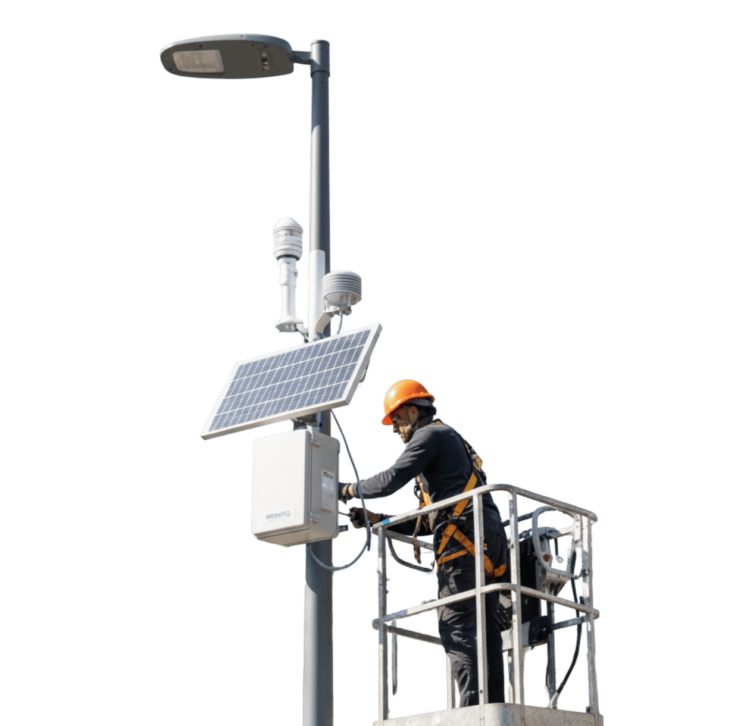
The PGD option guarantees continuous operation when installed in streetlights, traffic lights, etc., while the solar panel with battery allows for total energy autonomy for remote monitoring even in areas with few hours of daylight or poor solar orientation, as a larger solar panel option is available.


Ready to install and collect data

Ready to install and collect data

The monitoring equipment comes factory-ready for quick and easy installation by the customer: in just a few minutes, the portable monitoring station will be ready to start recording data thanks to its IoT connectivity options.

Contact

Remote calibration service for outdoor air monitoring stations

Remote calibration against standard equipment

Electrochemical sensors designed to measure gases undergo a rigorous calibration process in our laboratory before shipment, using our own calibration algorithms against a reference and cross-checked with a duly certified reference station.

The Nanoenvi Analytics service offers different remote calibration options without the need to physically move the measuring station, continuously monitoring the values recorded by the equipment against those of the nearest control station at its final location.

The monitoring system also incorporates the ability to generate predictions about the expected evolution of pollutant levels. This allows the most appropriate time to perform a new calibration to be selected, avoiding doing so during episodes of intrusion or abnormal conditions that could alter the results.

They already trust Nanoenvi EQ

In-house platform for data monitoring

In-house platform for data monitoring

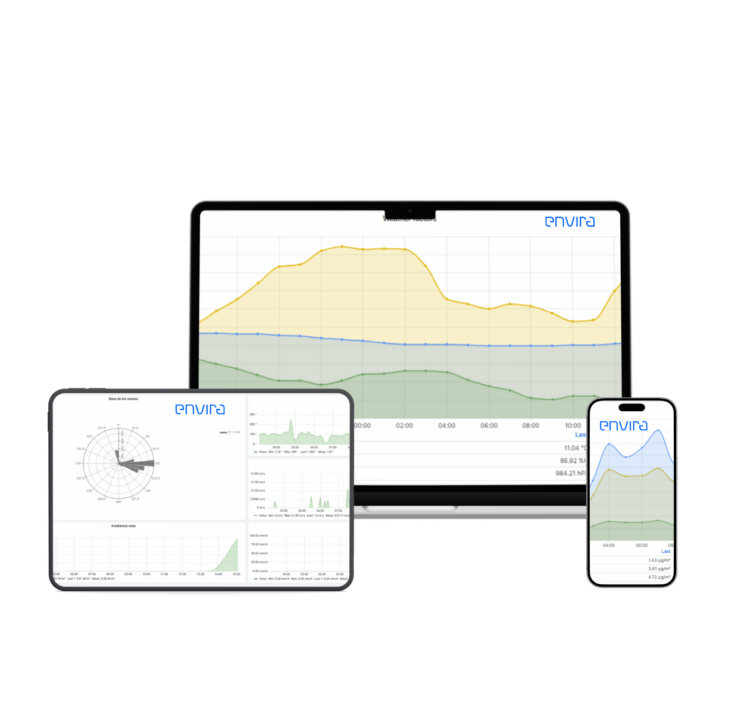
Envira has designed an easy-to-use multi-user dashboard: all you need is internet access to view the monitored data anytime, anywhere.

Contact

Everything you need in one Dashboard

Data is collected continuously every minute and transmitted to the platform so that parameters can be monitored in real time and historical data can be reviewed.

The Nanoenvi® EQ system's own platform also allows for the generation and export of reports and notification via customised alarms by email when the concentration of a pollutant exceeds the pre-set threshold.

Open data integration #CloudFree


The Nanoenvi EQ professional air quality monitoring solution is designed based on the #CloudFree philosophy, offering open and integrable communication via MQTT with any third-party platform or application, without relying on proprietary software or paid subscriptions.

Unlike closed systems, the standard MQTT protocol allows you to integrate the JSON data sent by Nanoenvi EQ directly into any dashboard, data management and exploitation system or Business Intelligence platform, independently of proprietary software and with total flexibility.


Infographic on Nanoenvi EQ data integration possibilities


Nanoenvi EQ Catalogue

Download

Nanoenvi EQ Catalogue

Discover all the possibilities offered by the Nanoenvi EQ portable station for monitoring outdoor air quality

Download Now

TECHNICAL SPECIFICATIONS

Power

100-240 VAC @ 50-60 Hz (PGD/PGC) | PoE++ (IEEE 802.3bt) | Solar panel (included)

Max. Consumption

30W (PGC / SP) | 55W (SP-L) | 60W (PGD) | 55W (PoE)

Average Consumption

2 W

Battery

96Wh LiFePO4 (PGD / SP / SP-L)

Autonomy

24x7

Environmental operating conditions

- 20 ~ 55ºC / 0 ~ 99%RH (without condensation)

Case material

ABS, polyurethane, aluminium and stainless steel

IP Protection

IP65

Max. Weight

2Kg (PGC / PoE) | 3,5Kg (PGD / SP) | 4,5Kg (SP-L)

Solar panel weight with bracket

3,2Kg (SP) | 4,2Kg (SP-L)

Dimensions

500x260x200 mm

Solar panel dimensions

560x350x25 mm (SP) | 545x668x25 mm (SP-L)

Communications

4G/LTE | Ethernet | WiFi | LoRaWAN

Pollutant gases

NO, NO2, NOx, O3, SO2, H2S, NH3, CH4, CO, CO2 & COVs

Particulate Matter

PM1, PM2,5y PM10

Other Parameters

Temperature, humidity, atmospheric pressure, noise, rainfall, solar radiation, illuminance, wind speed and direction

Acquisition period

Minutal

LoRaWAN acquisition period

Depending on the submission period

Sending Period

From 1 to10 minutes

Sending Period (LoRaWAN variant)

From 2 to 15 minutes

Example Configurations and Use Cases

Works and construction

Control of airborne particles generated by demolition, construction and general building works

PM1, PM2.5 and PM10 airborne particles

Wind direction and speed sensors

Autonomous and robust system with IP65 protection

Urban Air Pollution

Create hyperlocal air quality networks and monitor air quality and noise in urban areas.

Typical urban pollutants: NO, NO₂, NOx, O₃, SO₂ and CO

PM1, PM2.5 and PM10 airborne particles

Environmental noise (dB)

Infrastructure

Monitoring parameters that influence pollution in large infrastructure, such as ports and airports

NO, NO₂, NOx, SO₂ and CO sensors

PM1, PM2.5 and PM10 particles

Environmental noise (dB)

Fenceline monitoring

Fenceline control of industrial facilities, allowing verification of the impact of activities on the environment

PM1, PM2.5 and PM10 particles

NO₂, SO₂, H₂S, CH₄ and CO, among others

Weather data for dispersion analysis

Fugitive emissions

Detects gas leaks that may occur in numerous industrial processes in real time

Potential leaks of TCOV, CH₄, H₂S, NH₃, CO₂

Complement in LDAR campaigns

Source triangulation using wind direction

Mines and quarries

Controls suspended particles and detects the concentration of gases released during extraction

PM1, PM2.5 and PM10 particles

CH4 control during extraction

Autonomous and robust system with IP65 protection

Treatment plants and WWTPs

Improves the management of unpleasant odour episodes and reduces complaints caused by the most problematic gases

Measures odours caused by H₂S

Monitors odours from ammonia (NH₃) and methane (CH₄)

Wind direction and speed sensors

Waste management

Controls the main gases released during decomposition processes in composting, biogas plants, etc.

Monitor CH₄ associated with biogas

Detection of H₂S and NH₃

CO₂ control to maximise energy recovery

Agriculture and Livestock

Monitoring of the parameters that directly affect crops and plantations

Controls odours caused by NH₃.

Monitors odours from CH₄

Solar power and LoraWAN or 4G connection

Research

The flexibility of the system makes it particularly valuable for academic research on air pollution.

Modular configuration tailored to the project

Open MQTT protocol

Multiple communication options (4G, WiFi, Ethernet, LoRaWAN)

Air Quality

Monitoring of all parameters exclusively affecting air quality.

Temperature, humidity and atmospheric pressure sensors

CO, CO₂, VOC, O₃, NO₂ and SO₂ sensors

PM1, PM2.5 and PM10 particles

WHO Recomendations

Monitoring of the parameters recommended by the WHO for outdoor air quality.

Temperature, humidity and atmospheric pressure sensors

O₃, NO₂ and SO₂ sensors

PM1, PM2.5 and PM10 particles

Frequently asked questions (FAQ) about Nanoenvi EQ and outdoor air quality monitoring

What is Nanoenvi EQ and how is it used in monitoring ambient air quality?

Nanoenvi EQ is an IoT device specialised in monitoring air pollution, capable of simultaneously measuring up to 11 toxic gases, airborne particles (PM1, PM2.5 and PM10), environmental noise and meteorological parameters in real time. It is used to obtain indicative measurements of air quality and urban pollution, Smart Cities projects, pollution studies, industrial fugitive emissions control, environmental assessments and odour control in wastewater treatment plants, waste management plants and livestock farms, among others.

What are the atmospheric pollutants and environmental parameters measured by Nanoenvi EQ?

This air quality meter analyses pollutant gases (NO₂, NO, NOx, O₃, SO₂, H₂S, CO, NH₃, CO₂, CH₄ and VOCs), suspended particles (PM1, PM2.5, PM10), noise and meteorological variables (temperature, humidity, pressure, wind, solar radiation and illuminance). All this in a single modular device that can be configured according to the needs of each project.

What advantages does Nanoenvi EQ offer over other air quality monitors?

Thanks to its compact, modular design, it can be installed flexibly in various locations. It offers free integration via MQTT, compatibility with proprietary and third-party platforms, remote configuration and redundant offline storage. Its sensors’ professional precision and IP65 protection ensure reliability even in demanding environments.

What is the estimated delivery time for a Nanoenvi EQ measuring station?

As Nanoenvi EQ portable stations are fully user-configurable, they are made to order with a delivery time of two to three months from the date the order is placed.

How do Nanoenvi EQ's real-time communications and data transmission work?

The Nanoenvi EQ device acquires environmental data at regular intervals and transmits it to an MQTT broker via 4G/LTE, Wi-Fi, Ethernet or LoRaWAN communications. The data is sent in the form of structured JSON messages, which facilitates integration with numerous environmental management platforms.

What are the power supply and battery life options for Nanoenvi EQ for continuous air quality monitoring?

The equipment can operate using a conventional mains power supply, intermittent mains power plus battery, PoE++ or solar power, thanks to the solar panel and battery. This flexibility guarantees 24/7 energy autonomy even in remote or difficult-to-access locations, ensuring that environmental pollution data is always available.

How long do Nanoenvi EQ sensors last and how are they maintained?

Due to their nature and the environments in which they are used, electrochemical sensors for measuring gases have a useful life of up to two years, after which they must be replaced. This replacement can be carried out by the customer without sending the equipment back to the factory, although Envira also offers this service.

To ensure maximum reliability, it is recommended that periodic calibrations are carried out against reference stations every 3–6 months to correct the drift inherent in these sensors, in addition to regular visual inspections and cleaning of the equipment.

Can Nanoenvi EQ data be viewed and analysed without relying on proprietary software?

Yes, the system is 100% CloudFree and open: users receive data via MQTT to their own software, platform, app, or SCADA. Envira offers, as a service, its own visualisation interface with report generation, customised alerts when thresholds are exceeded, and historical data analysis.

Which IoT air quality monitor is compatible with MQTT and powered by solar panels?

Nanoenvi EQ enables professional environmental monitoring with solar panel, redundant storage and open MQTT communication, integrable into Smart City projects, industry and autonomous mobile networks.

see more

Do you want to become a distributor?

Send your request