solutions
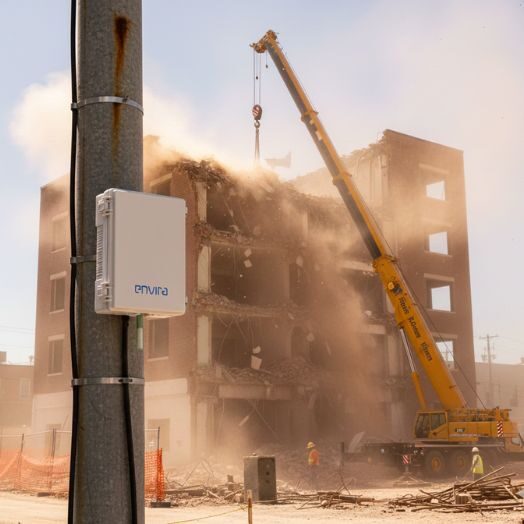
Environmental management in civil engineering and construction has evolved. The implementation of IoT environmental monitoring systems in construction projects has become the most effective way to control dust, noise and polluting gases on construction sites, reducing the risk of non-compliance and work stoppages.
These systems enable the digitalisation of the Construction Environmental Management Plan (CEMP) associated with the Environmental Impact Assessment (EIA), providing continuous, real-time monitoring of PM10 and PM2.5 particles, polluting gases and environmental noise. In this way, they facilitate the monitoring of the preventive and corrective measures required by environmental assessment legislation.
By integrating continuous monitoring into the Environmental Management of Construction Sites (EMCS), construction companies align themselves with environmental assessment monitoring and follow-up obligations, while optimising costs, reducing the risk of stoppages and better managing the impacts of earthworks, demolition and heavy machinery.
Legal compliance
Continuous environmental monitoring is the most reliable way to demonstrate compliance with environmental regulations and city noise ordinances.
24/7 monitoring
Replace spot measurements of dust and noise with automated 24/7 monitoring. IoT devices send immediate alerts to the site manager when pre-set limits are exceeded.
Claims' defence
In urban environments, neighbourhood complaints about noise or dust are common. Having a historical record and traceable data acts as ‘insurance’ for the project, avoiding unnecessary downtime and providing solid evidence.
Reporting
Optimise time by reducing administrative burden: Envira's cloud-based management platforms automate data collection and environmental monitoring reporting.
Nanoenvi EQPM: diffuse airborne dust emissions control in construction and building sites
Many Environmental Monitoring Plans (EMPs) often include specific measures to “minimize the emission and dispersion of dust and particles” through watering, road cleaning, and control of machinery traffic.
Continuous monitoring with Nanoenvi EQPM allows real-time verification of PM1, PM2.5, and PM10 particulate matter levels to determine whether the measures implemented on site are effective, as well as to document compliance.
The Nanoenvi EQPM device is fully configurable and can be equipped with:
Nanoenvi EQ, the most comprehensive environmental monitoring system for construction sites
On the most demanding construction projects, simply controlling dust is not enough. Work carried out in urban areas, confined spaces such as tunnels, or low-emission zones (LEZs) requires a comprehensive environmental monitoring system that simultaneously monitors airborne particles, polluting gases, noise, and weather conditions.
That is why Nanoenvi EQ is the most comprehensive environmental monitoring solution for construction and demolition sites, continuously measuring the main pollutants generated by diesel machinery, heavy traffic, and the construction activities themselves, providing a global, real-time view of air quality and noise in the vicinity of the site.
Thanks to this combination of sensors, Nanoenvi EQ allows you to:
Nanoenvi dB, legally valid noise monitoring for construction sites and urban projects
When construction projects are carried out in sensitive environments (hospitals, schools, densely populated residential areas) or when municipal ordinances require strict control of environmental noise, measurements must be taken using instruments that are subject to legal metrological control.
Nanoenvi dB integrates a Class I sound level meter that complies with the UNE-EN 61672-1:2014 and UNE-EN 61260-1:2014 standards, meeting the requirements of the legal metrology regulations applicable to instruments for measuring audible sound.
This makes it the right choice when legally valid measurements are required for complaints, inspections, or litigation, while Class II sound level meters are more appropriate for daily operational control.
In many projects, a single monitoring point is not enough to understand the real impact of the work on its surroundings. Wind direction, urban geometry, the presence of nearby buildings or sensitive receptors make it necessary to deploy a distributed environmental monitoring network that covers the different emission sources and potentially affected areas.

Envira’s solutions allow you to set up continuous monitoring networks, including a cloud-based IoT platform accessible from any device with an internet connection.
From this platform, the DAO and the Site Manager can:
It is mandatory to comply with noise limits and minimize dust emissions, but the specific form of control may vary depending on the project and the municipality.
Projects subject to Environmental Impact Assessment (EIA) usually include controls on construction noise and dust and particle emissions from earthworks and machinery traffic. These controls may combine visual inspections, measurement campaigns with an approved sound level meter, and, in some cases, continuous monitoring systems.
On the other hand, city noise and air quality ordinances set limits and conditions for construction work (schedules, permitted levels, measures to minimize smoke and dust emissions, etc.). Some administrations may require acoustic studies or measurement campaigns in order to grant certain permits, especially in sensitive environments or at night.
Continuous noise and particle monitoring systems are not always required by law, but they are the most robust and traceable way to demonstrate that the construction site complies with local ordinances, reducing the risk of penalties and shutdowns.
Class I (Nanoenvi dB) offers maximum precision and is the only one valid for measurements with legal effects, expert reports, or sanctions. Class II (integrated in Nanoenvi EQPM) has a slightly higher tolerance margin and is perfect for daily operational control, trend monitoring, and internal site management, being more economical.
Yes. All Nanoenvi devices are IoT systems that send data to a cloud platform. You can access real-time noise, dust, and gas levels from any device (mobile, tablet, or computer), set up alerts, and download reports without having to go to the site.