Airborne dust monitoring equipment
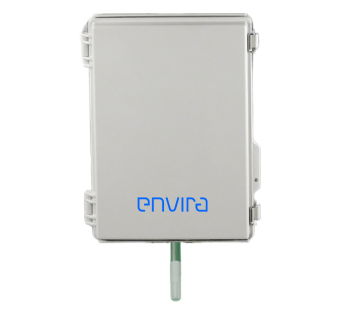
Nanoenvi EQPM is an IoT-based airborne particle sensor specifically designed to monitor and control particulate matter suspended in outdoor air.
Continuous monitoring of PM10 and PM2.5 particles is key to controlling outdoor air quality and environmental compliance in different areas. Continuous, real-time monitoring of dust suspended in the ambient air allows the effectiveness of emission control systems to be assessed, health to be protected and regulatory penalties to be avoided.
The Nanoenvi EQPM particulate matter sensor, based on IoT technology, has been specifically designed for the accurate and continuous monitoring of particulate matter in the ambient air in any environment: from construction and demolition sites, ports, airports, mines and quarries, to industrial and waste treatment plants.
Its ability to generate reliable data, integrate it with environmental management systems via MQTT and facilitate decision-making makes Nanoenvi EQPM the ideal solution for controlling dust and suspended particles even in the most demanding environments.
Ports and airports
Activities such as bulk material handling and container movements in ports, vehicle traffic or aircraft take-offs and landings at airports generate large amounts of airborne dust.
Construction works
Heavy machinery, demolition and dismantling of structures, digging of trenches and pits or handling and storage of materials are some of the construction activities that produce high levels of suspended particulate matter.
Manufacturing
Manufacturing industries, especially cement, mining and metallurgical industries are significant sources of dust and particulate matter in most of their production processes.
Waste treatment
The unloading, shredding and compacting of waste and its subsequent incineration in composting and waste treatment plants are processes that emit large quantities of particulate matter into the atmosphere.
Particulate matter monitor for Ports and Airports
The continuous monitoring of airborne particles in ports and airports is essential to mitigate the environmental impact of loading and unloading materials, as well as vehicle, ship and aircraft traffic.
A real-time PM particle monitoring system allows operations to be adapted according to outdoor air quality, avoiding pollution peaks and protecting the health of both workers and users.
It also facilitates the obtaining of environmental certifications and compliance with national and international standards in critical infrastructures.
PM particle sensor for dust control on construction sites
Using a continuous PM2.5 and PM10 particle monitor on construction and demolition sites ensures effective control of dust generated in the ambient air, protecting the health of workers and the surrounding community, as well as avoiding potential complaints from neighbours.
Thanks to real-time monitoring, it is possible to comply with environmental regulations and anticipate episodes of high pollution, facilitating decision-making to reduce emissions and avoid penalties.
In addition, Nanoenvi EQPM can be configured with an ambient noise monitoring sensor, which is very useful in this area.
A continuous monitoring system helps prevent complaints and improves the image of the project, positioning it as a benchmark in sustainability and social responsibility.
Particulate Matter control system for the Manufacturing Industry
In industries such as concrete, mining and quarrying, or metallurgical plants, real-time monitoring of PM particles minimises occupational risks and ensures compliance with legal exposure limits.
Airborne particle sensors allow extraction processes to be adjusted, adequate ventilation to be provided, and corrective measures to be activated in dangerous situations.
Continuous monitoring optimises productivity, reduces costs associated with occupational illnesses and improves the social perception of extraction activities by providing transparent and verifiable data.
Airborne particle detector in Waste Treatment Plants
For waste treatment plants, real-time monitoring of PM particles is vital for controlling fugitive emissions and protecting both personnel and the surrounding urban or rural environment.
This control helps to respond immediately to incidents and optimise waste handling processes, complying with increasingly stringent environmental requirements.
The data collected continuously improves the transparency and reputation of the plant in the eyes of authorities and citizens.
The use of the Nanoenvi EQPM ambient air particle monitor ensures the correct functioning and effectiveness of dust control systems, such as the effect of water foggers during road works.

The airborne dust monitor comes with a multi-device display platform that provides real-time data on particle concentration in the air, as well as other parameters such as temperature, humidity, pressure and ambient noise. Customised alarms can be set in case any of the parameters exceed the established thresholds, so that corrective measures can be taken.

These air particulate detectors can be integrated into IoT networks using the most common M2M standard protocols: 4G, Ethernet, Wifi and LoRaWan.
Multiple power supply options
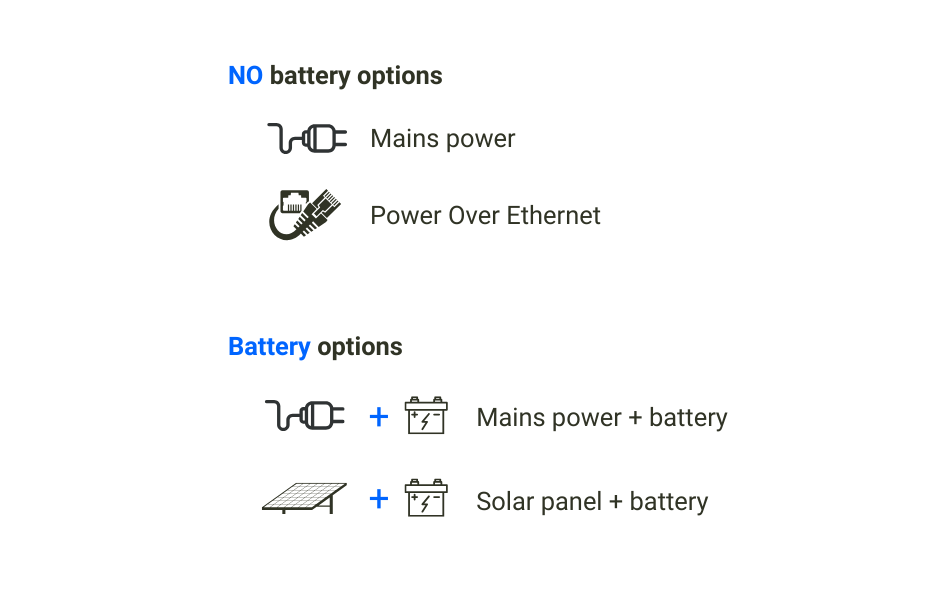
The Nanoenvi EQPM real time dust monitoring equipment have multiple power options specially designed to suit each project:
Power
100-240VAC @ 50-60Hz (PGD / PGC) | PoE ++ (IEEE 802.3bt) | Solar panel (included)
Max. Consumption
30W (PGC / SP) | 60W (PGD) | 55W (PoE)
Average Consumption
2 W
Battery
96Wh LiFePO4 (PGD / SP)
Autonomy
24x7
Environmental operating conditions
- 20 ~ 55ºC / 0 ~ 99%RH (without condensation)
Case material
ABS, polyurethane, aluminium and stainless steel
IP Protection
IP65
Max. Weight
2Kg (PGC / PoE) | 3,5Kg (PGD / SP)
Solar panel weight with bracket
3,2Kg (SP)
Dimensions
500x260x200 mm
Solar panel dimensions
560x350x25 mm
Connectivity
2G/3G | 3G/4G/LTE | Ethernet | WiFi
Particulate matter
PM1, PM2,5y PM10
Period of acquisition
30 seconds
Dispatch period
From 1 minute until 10 minutes
The Nanoenvi EQPM is specifically designed for highly reliable monitoring of particulate matter (PM) in environments with high emission potential. Its key applications include:
The main differences are the type of monitoring, cost and flexibility. Reference stations are the legal standard for regulatory compliance; they are highly accurate but also very expensive and complex to maintain.
The Nanoenvi EQPM provides highly reliable indicative measurements. This means that, although it is not a reference device, it offers excellent correlation with them at a much lower cost (both purchase and maintenance). Its key advantage is that it allows the deployment of high-density monitoring networks, covering large areas (neighbourhoods, industrial perimeters, construction sites) that would be economically unfeasible to monitor with reference stations alone.
The Nanoenvi EQPM uses an optical particle counting (OPC) sensor. This technology works by emitting a laser beam through the airflow entering the sensor. When a particle (PM10, PM2.5 or PM1) passes through the laser, it scatters the light. The sensor detects this scattering and, based on the intensity and number of light pulses received, calculates the concentration and size of the particles in the air in real time.
Yes. The Nanoenvi EQPM can integrate a weather sensor to monitor key parameters such as temperature, relative humidity, and atmospheric pressure. Optionally, it can also include wind direction and speed measurements. Having this meteorological data alongside particle data is crucial, as it allows for the contextualisation of pollution levels and is essential for feeding dispersion models.
No, installation is very simple and quick. The equipment is designed to be plug and play. Thanks to its compact and lightweight design, it can be easily installed by one or two people in minutes. It can be anchored to posts, lampposts, building facades or any other street furniture, requiring only a power supply point (or the installation of a solar panel).
The Nanoenvi EQPM is designed to require minimal maintenance, which is one of its main advantages. Maintenance mainly focuses on the particle sensor (OPC) and includes:
Do you want to request your Quotation?