solutions
In the extractive sector, mines and quarries need solutions that allow them to monitor airborne dust (PM10 and PM2.5) and noise impact in real time, in order to reduce occupational health risks and minimise complaints from neighbouring communities.
In addition, coal mining faces its biggest regulatory challenge in decades: the entry into force of Regulation (EU) 2024/1787 has transformed environmental management and promotes the use of direct and continuous measurements with sufficient technical accuracy to demonstrate total control of methane emissions in both active and closed coal mines.
At Envira, we offer a continuous environmental monitoring solution for mining and quarrying that integrates gas detection (including methane), particulate matter (PM10 and PM2.5) and noise detection into a single compact and robust IoT device.
Smart dust management
It monitors PM10 and PM 2.5 particles in real time and activates misting systems only when necessary, saving water and operating costs associated with dust control in quarries and open-pit mines.
Compliance (EU) 2024/1787
Generates traceable historical methane (CH4) concentration data that facilitates the preparation of Monitoring, Reporting and Verification (MRV) reports required by Regulation (EU) 2024/1787 for active and closed coal mines.
Early detection of leaks
Instantly identifies peaks in methane concentration and fugitive emissions, making it the ideal complement for optimising the LDAR technique and allowing action to be taken before a leak becomes a safety incident or an environmental fine.
Defence against complaints
It has an unalterable historical record to technically support that dust, noise, or methane emissions were within established limits, correlating the data with wind direction to confirm or rule out sources external to the mine or quarry.
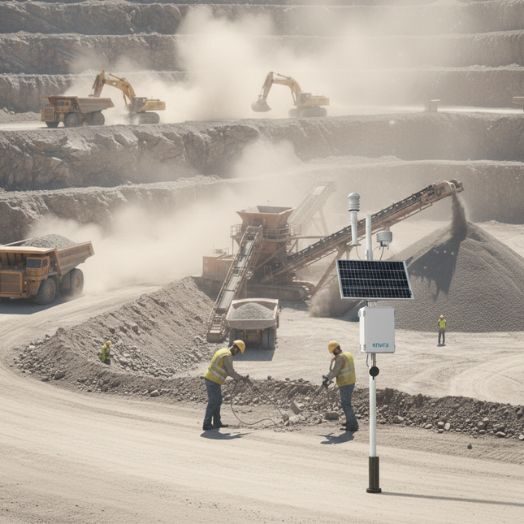
Nanoenvi EQ devices are robust, compact and low-maintenance devices, particularly suited to the complex terrain and harsh environmental conditions found in mines and quarries.
They are based on IoT technology and, thanks to multiple configuration options for sensors, power supply and connectivity, they enable continuous measurement of methane (CH4) emissions, gases such as SO2, VOCs or NOx, dust and noise in a single device.
The features that make Nanoenvi EQ ideal for the mining sector are:
Continuous measurement of methane (CH4) and Regulation (EU) 2024/1787
The continuous monitoring of methane emissions in coal mines is a strategic priority in European climate policy. Regulation (EU) 2024/1787 establishes a rigorous framework for reducing CH4 emissions in the energy sector, which directly affects both active and closed coal mines.
With Nanoenvi EQ, it is possible to:
Continuous monitoring of dust and particulate matter PM10 and PM2.5 in quarries
Airborne dust is the most visible impact of a quarry. The Nanoenvi EQ device uses an optical particle counter to continuously measure PM1, PM2.5 and PM10 fractions.
By combining this data with meteorological sensors (especially wind speed and direction), the platform allows you to:
For locations where only suspended dust needs to be measured, we offer Nanoenvi EQPM, a variant of the Nanoenvi family focused on continuous measurement of particulate matter that significantly reduces the cost of the equipment.
Continuous monitoring of noise and environmental impact in mining
The noise from heavy machinery, material transport and blasting is one of the main sources of neighbourhood complaints and social conflicts in mines and quarries. Nanoenvi EQ can incorporate a sound level meter module to:
When legally valid noise measurements are required, for example for disciplinary proceedings or official reports, the Nanoenvi dB equipment can be integrated with a Class I sound level meter certified by the CEM, capable of continuously recording LAeq sound pressure levels and impulsive noise peaks, with data that is valid for the competent authorities.
The continuous emissions monitoring solution for mining and quarrying is complemented by a cloud platform that centralises all the data captured by the sensors.
From a single responsive web dashboard (accessible from a tablet, smartphone or computer), it is possible to:

An all-in-one IoT device such as Nanoenvi EQ significantly reduces installation, cabling and maintenance costs compared to traditional bulky monitoring stations. By integrating into a single device:
This allows for the deployment of dense and flexible monitoring networks in mines and quarries, with IP65 protection for working in dusty and wet environments, and solar + battery power and LoRaWAN or 4G connectivity for remote environments.
Effective dust control requires continuous monitoring of PM10, PM2.5 and even PM1 particulate matter fractions, especially around the perimeter of the operation and in areas where dust is most likely to be generated (traffic lanes, loading areas, crushing areas).
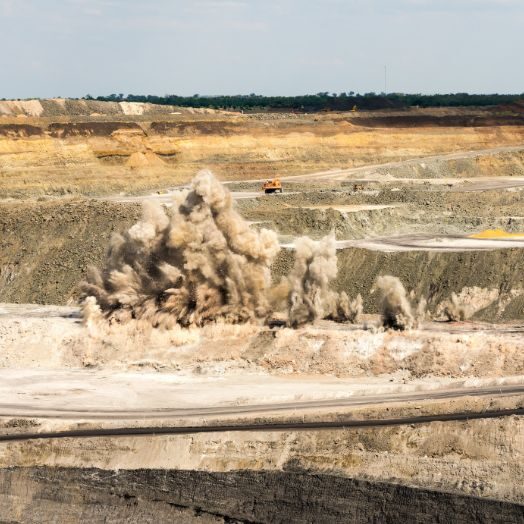
By correlating this data with wind speed and direction, it is possible to identify whether the dust generated by blasting or transport is exceeding legal limits outside the quarry and, if so, to activate corrective measures such as automated track watering or optimisation of operating schedules.
By storing historical data on methane, dust and noise and generating automatic reports, mining companies can:
Regulation (EU) 2024/1787 stipulates that mining companies must design robust Monitoring, Reporting and Verification (MRV) systems for their methane (CH4) emissions. The aim is to reduce reliance on generic estimates and move towards direct, continuous measurements at key emission sources (such as ventilation wells and drainage stations) wherever technically feasible.
Continuous monitoring solutions such as Nanoenvi EQ help to comply with this framework by providing historical data records, real-time alarms and traceability, facilitating mandatory external audits and the preparation of emissions inventories.
The new European regulatory framework on methane in the energy sector (Regulation (EU) 2024/1787) stipulates that Member States and operators must inventory closed or abandoned coal mines and establish monitoring plans to detect possible fugitive methane emissions.
Continuous monitoring using autonomous, solar-powered devices with wireless communication is one of the most efficient ways to manage these environmental liabilities, reduce the risk of gas accumulation and protect nearby populations.