en
es en
Phone +34 985 73 39 52

solutions

Airport local air quality, noise and emissions monitoring system

Home » Sectors » Airport local air quality, noise and emissions monitoring system

Airports are vital economic drivers, but they act as major sources of emissions. The sector faces the challenge of implementing effective and intelligent environmental monitoring at airports to control noise pollution and ensure air quality during ground support equipment (GSE) operations and landing and take-off (LTO) cycles, in compliance with strict ICAO standards and the new Directive (EU) 2024/2881 on ambient air quality.

Hybrid Environmental Monitoring Network for Airports

We have developed a comprehensive solution based on the deployment of mixed networks for air quality and noise monitoring. This network combines the legal accuracy of reference instrumentation with the capillarity of IoT sensors to obtain a complete environmental data mesh.

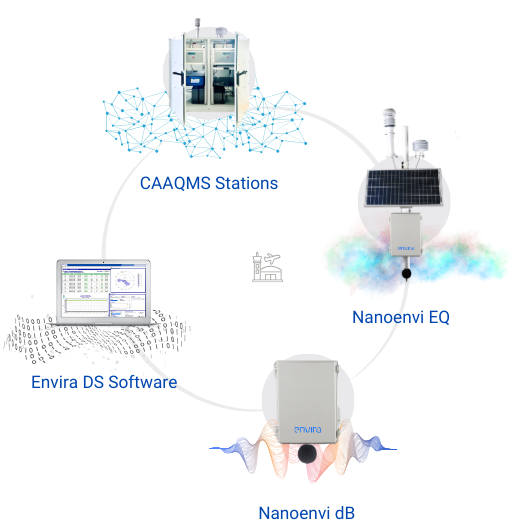
This comprehensive environmental monitoring system for the aviation sector is based on three pillars:

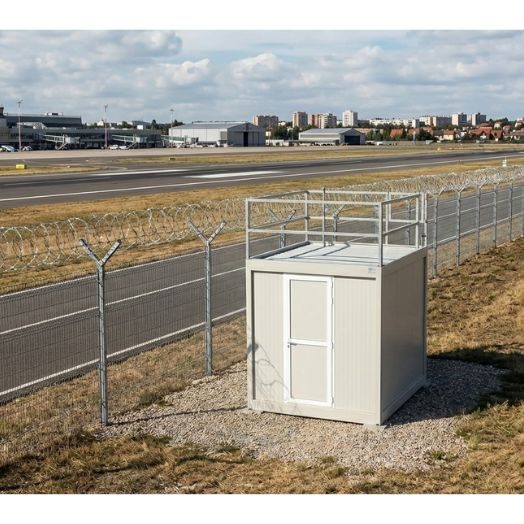
  • Reference stations (legal compliance): fixed cabins with certified analysers to officially report to the authorities and verify compliance with regulatory limits.
  • IoT Sensor Network (Nanoenvi EQ and Nanoenvi dB): compact devices to densify the network, creating hybrid networks for indicative monitoring of pollutant gases, suspended particles and noise, enabling the creation of dynamic loal air quality and noise maps around the fenceline and runways at low cost.
  • Envira DS Platform: cloud software for the acquisition, verification and validation of collected data and its submission to the relevant authorities in the required formats.

Advantages of implementing an environmental monitoring solution at airports

Regulatory compliance

Regulatory compliance

The use of type-approved instrumentation at fixed stations ensures the quality and traceability of data required by the main regulations.

Full monitoring coverage

Full monitoring coverage

By including both CAAQMS and indicative measurements throughout the airport environment, dynamic pollution maps can be produced continuously and in real time.

Cost reduction and optimisation

Cost reduction and optimisation

Thanks to the combination of CAAQMS with IoT sensors, it is possible to monitor the entire airport perimeter at a much lower cost than if only reference instrumentation were used.

Data validation system

Data validation system

The comprehensive system has software that allows data validation and export in the appropriate format for subsequent submission to the authorities.

Already placed their trust on us


Logos aeropuertos


Optimum location for the environmental monitoring network within the airport

The design of an emissions monitoring network at an airport is not random: it must be aligned with new European regulations and meet the implementation criteria required by the regulations to ensure the legal representativeness and operational viability of the data.

Location of AAQM stations at the airport

These stations will collect data on pollutants such as NO2, NOx, SO2, PM10, PM2.5, and UFP particles, benzene/BTEX, and CO, and will be strategically located according to the wind rose:

  • Upwind: to establish the pollution “baseline” for the area (clean air or pollution outside the airport).
  • Downwind: in the prevailing wind direction towards inhabited areas, to measure the real impact of airport emissions on the population.

Indicative readings at airports using Nanoenvi IoT sensors

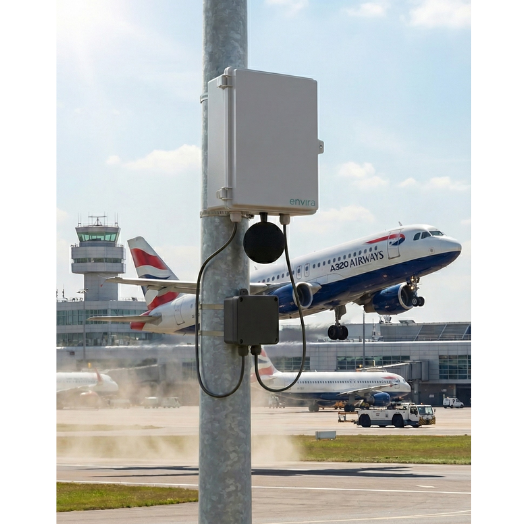
Devices such as Nanoenvi EQ for monitoring air quality and Nanoenvi dB for monitoring noise are compact, easy to install (on streetlights or poles), and low in cost and maintenance, making them the ideal alternative for densifying the environmental monitoring network and creating dynamic maps of noise and atmospheric emissions.

In addition, the new Directive 2024/2881 promotes the use of indicative measurements to complement information from fixed stations, assess the spatial distribution of pollution, and feed into air quality models.

It is therefore advisable to deploy this network of sensors in:

  • Service Areas (GSE): to monitor air quality and protect the health of runway operators, mainly looking for NOx and VOCs.
  • Fence-line monitoring, i.e., surrounding the perimeter of the site, to determine whether the pollution comes from the airport or from external sources (urban traffic).

Continuous, real-time monitoring of environmental data at airports


The environmental data collected by both reference stations and Nanoenvi IoT devices is integrated into Envira DS, a cloud-based data management software that not only allows for the continuous, real-time assessment of pollutant concentrations, but also verifies and validates the data, ensuring its quality.

Environmental monitoring system for airports infography

In addition, it allows alerts to be implemented that notify those responsible via SMS or email if any pollutant parameter exceeds pre-established thresholds, export reports with historical data, and send validated data to the relevant authorities in the required format.

Frequently Asked Questions (FAQ) about air quality, noise and emissions monitoring at airports

What is a hybrid environmental monitoring network and what are its advantages?

A hybrid network is a system that combines type approved CAAQM stations (high precision and legal validity) with a dense network of IoT sensors (such as Nanoenvi EQ and dB). The main advantage is cost optimization: it allows 100% coverage of the airport perimeter and the creation of dynamic pollution maps at a much lower cost than installing reference stations alone, while maintaining legal rigor where required.

What air quality and noise regulations must airports comply with today?

Airports must comply with ICAO (International Civil Aviation Organization) standards and European regulations. Specifically, they must comply with Directive 2002/49/EC for environmental noise management and the new Directive (EU) 2024/2881 on air quality. Envira’s solution guarantees data traceability and the use of the necessary reference instrumentation to report to the authorities under these legal frameworks.

Where should pollution meters be installed at an airport?

The design of the monitoring network is not random; it follows regulatory representativeness criteria. The key locations are:

  • Windward and leeward: to establish the baseline (incoming clean air) and measure the actual impact of operations on neighboring inhabited areas.
  • Service Areas (GSE): to monitor the air breathed by operators on the runway, monitoring gases such as NOx and VOCs.
  • Perimeter Fencing (Fenceline): to distinguish external sources (urban traffic) from the airport’s own emissions.
Is it possible to distinguish whether the pollution comes from airplanes or external traffic?

Yes. Through perimeter monitoring (Fenceline monitoring) and wind data correlation (anemometry), the system can distinguish whether NO2 or particle peaks originate from airport operations or external sources such as highways or neighboring cities.

How does Envira DS software help with LTO emissions management and ground operations?

Envira DS software centralizes data from reference stations and sensors on a single cloud platform. It allows real-time data validation, generates official reports for the administration, and configures automatic alerts (SMS/Email) if noise or particle thresholds are exceeded during LTO (takeoff and landing) cycles or ground operations.

see more