solutions
Successful environmental management of a modern port is no longer limited to basic compliance. It requires active intelligence on land operations, maritime traffic and the port-city interface. To achieve this, it is essential to monitor air quality, noise impact, odour episodes and port water quality.
At Envira, we assist Port Authorities with a comprehensive environmental monitoring solution based on sensors to measure air and water pollution, enabling the deployment of an extensive network for continuous, real-time monitoring. This ensures compliance with the initiatives for improving environmental quality and guarantees sustainability, protects biodiversity and ensures coexistence with the urban environment.
Air quality
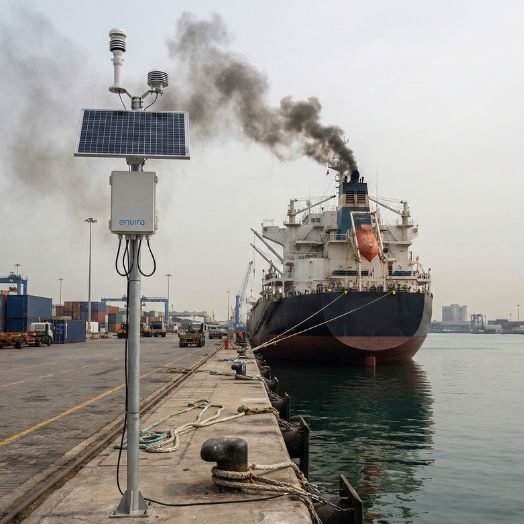
Continuous monitoring of critical atmospheric pollutants: SO₂, NO₂, NOx, VOCs, and PM 2.5 and PM10 particulates. Immediate detection of diffuse emissions at bulk terminals and supervision of ships' compliance with the MARPOL Convention.
Smells impact
Odour episodes are the main cause of complaints from citizens. Monitoring volatile organic compounds (VOCs) and sulphides allows us to anticipate nuisances, managing operations to prevent odours from spreading to inhabited areas.
Noise pollution
Industrial and logistical noise requires strict control, especially during night-time operations. Monitoring with Class 1 sound level meters guarantees legally valid data to defend port management and adjust dynamic noise maps.
Water quality
Early detection of accidental spills (hydrocarbons) or changes in turbidity due to dredging works is essential to protect marine biodiversity and avoid severe penalties for non-compliance with water regulations.
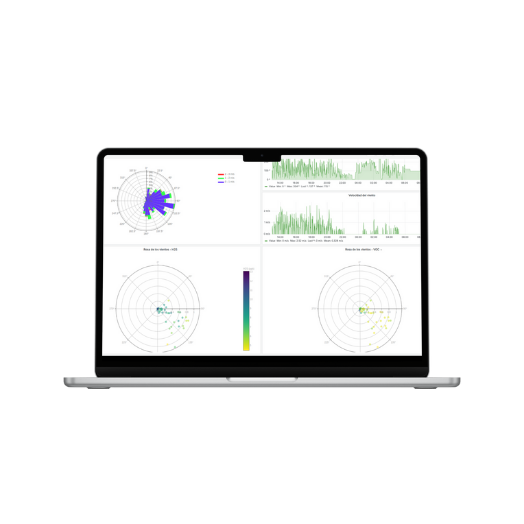
Our Cloud platform integrates data from the entire sensor network (air, water and noise) into a single dashboard accessible 24/7:

Air Quality Monitoring and MARPOL Compliance in Seaports
The use of continuous air quality monitoring devices in seaports has multiple advantages:
It is also common to find Ambient Air Quality monitoring stations, equipped with reference instrumentation, at the port-city interface. This provides legally valid data for the port’s defence against neighbourhood complaints.
With this same objective in mind, it is also common for port authorities to contract indicative monitoring campaigns.
Odour is the result of a chemical mixture, and to manage its impact, it is necessary to measure its components.
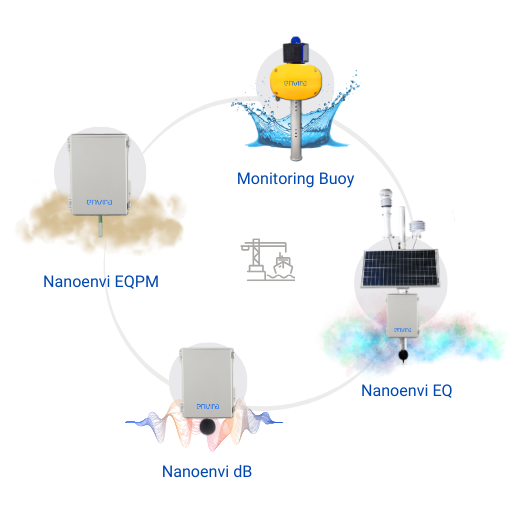
Continuous monitoring with the Nanoenvi EQ device provides real-time data on the concentrations of odour precursor compounds, such as:
This system also allows for the triangulation of the sources causing the odour by integrating meteorological data, identifying whether the odour is coming from a specific terminal, tank or vessel, facilitating an immediate response before complaints reach the public.
Therefore, Port Authorities need to:
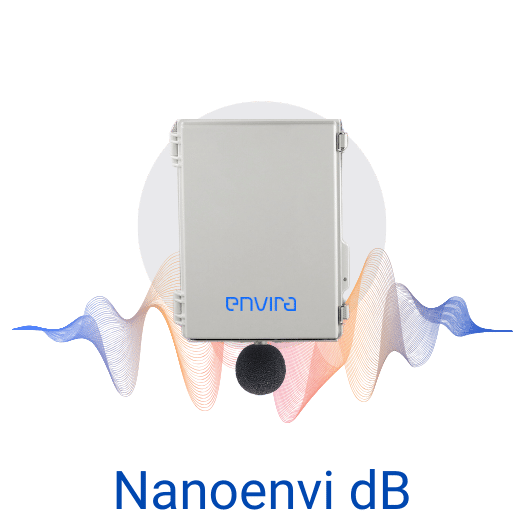
The deployment of a network of approved Class 1 sound level meters around the perimeter, such as those integrated into the Nanoenvi dB device, allows 24/7 measurement of Ld (day), Le (evening) and Ln (night) noise indices to adjust dynamic noise maps and verify acoustic quality targets.
Ensuring the good ecological status of port waters, quickly detecting changes in turbidity due to dredging works and reacting immediately to accidental or illegal oil spills is essential to protect marine biodiversity and avoid severe penalties for non-compliance with regulations.
The water quality monitoring buoys are equipped with multi-parameter probes that measure the main parameters affecting seawater quality:
This makes it easier for port authorities to establish systems for continuous, real-time monitoring of water quality to assess its chemical and ecological status, identify sources of operational pollution, ensure compliance with the MARPOL Convention and ROM 5.1-13.

The entire monitoring network (air, water, noise, and odours) is centralised on a cloud platform accessible via the web from any device. The platform allows you to view data in real time, extract historical reports, and, most importantly, set up automatic alerts via SMS or email when pre-established thresholds are exceeded, enabling proactive rather than reactive management.
To prevent operational downtime and fugitive dust clouds, we use the Nanoenvi EQPM monitor, designed specifically for solid bulk terminals. This device measures the concentration of PM10 and PM2.5 particles generated during loading and unloading in real time, allowing immediate corrective measures (such as watering or misting) to be activated before the dust reaches urban areas.
Yes. Through continuous monitoring of gases (SO2, NOx, VOCs) at the quayside, our sensors can detect ‘undeclared plumes’ and triangulate the source of the emission. This is a key tool for monitoring fuel switching and verifying whether ships are using their auxiliary engines instead of connecting to OPS (Onshore Power Supply) systems.
Odour episodes are complex due to chemical mixing. Our solution, based on high-precision electrochemical sensors, measures specific precursors such as hydrogen sulphide (H2S) and ammonia (NH3). By cross-referencing this data with wind direction and speed, the system triangulates the exact position, identifying whether the odour is coming from a treatment plant, a liquid bulk tank or a docked ship.
Absolutely. Envira’s monitoring buoys are equipped with multi-parameter probes that continuously monitor water quality. The system provides early warning of the presence of hydrocarbons or sudden changes in turbidity and suspended solids, which is vital for responding quickly to accidental spills or controlling the impact of dredging works on marine biodiversity.