Outdoor noise sensor
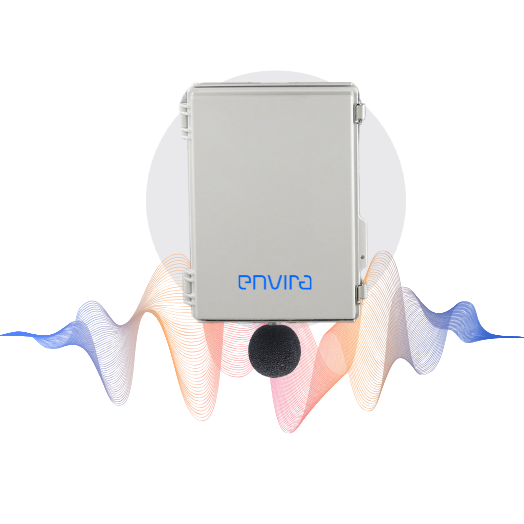
Nanoenvi dB is a professional acoustic surveillance system with an integrated Class 1 IoT sound level meter for continuous, legally valid noise monitoring in outdoor environments.
In an increasingly strict regulatory environment, defensible, accurate and legal measurements are required. This is how Nanoenvi dB was born, a professional noise measurement system that incorporates an approved Class 1 sound level meter, 4G connectivity and total autonomy for continuous environmental noise monitoring even in the most demanding environments.
The Nanoenvi dB acoustic monitoring system has been designed to operate outdoors in all weather conditions thanks to the IP65 protection of its casing, transmitting data in real time and ensuring that every decibel recorded complies with strict standards such as IEC 61672-1:2013 and IEC 61260-1:2014.
Metrological accuracy
Legal validity
Continuous monitoring
Energy independence
Robust design
Data platform
Unlike the low-cost sensors that have proliferated in the Smart Cities market, which offer indicative data but lack probative value in disciplinary or administrative proceedings, the Nanoenvi dB device is positioned as a hybrid solution that features a professional, approved Class 1 sound level meter, providing total metrological certainty in the continuous monitoring and surveillance of environmental noise.
Nanoenvi dB: the legally valid IoT solution
The system incorporates a certified sound level meter that complies with all the specifications of the IEC 61672-1:2013 standard and IEC 61260-1:2014 for Class 1 instruments.
The Class 1 sound level meter complies with the accuracy and stability of measurements required by law for the assessment and management of environmental noise and in relation to acoustic zoning, quality objectives and acoustic emissions.
This means that the data continuously recorded by the Nanoenvi dB environmental noise monitor is legally valid for:

IoT connectivity and smart energy autonomy for continuous noise pollution monitoring
Unlike traditional sound level meters and MEMS microphones, this environmental noise monitoring system integrates a complete sound level meter with a pre-polarised microphone compatible with IoT networks and sensors capable of transmitting data in real time thanks to 4G connectivity.
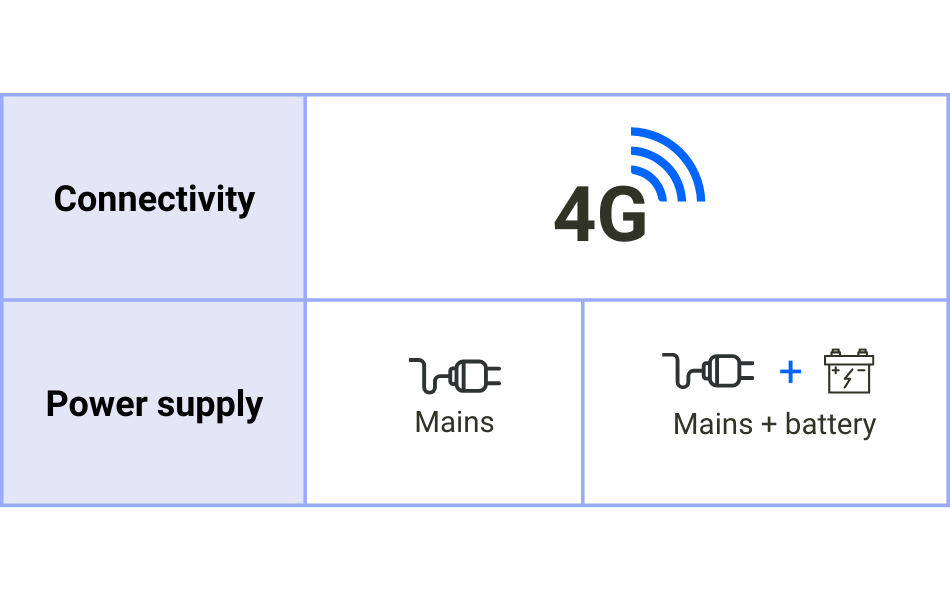
In addition, thanks to its rugged design with IP65 protection and PGC (direct connection to the mains) or PGD (mains + battery) power options, the device has a constant power supply, preventing failures and providing flat and stable frequency responses.
These options guarantee 24/7 operation at the best price and without complex civil engineering work.
While in certain cases spot testing with a traditional sound level meter is enough, Nanoenvi dB ‘s continuous monitoring is focused on environmental surveillance and acoustic behaviour control over time across large areas, such as entire neighbourhoods, infrastructure and industrial zones.
| Feature | Traditional Class 1 Sound Level Meter (Manual) | Nanoenvi dB System (Continuous Monitoring) | Why choose Nanoenvi dB? |
| Temporary Coverage | Spot sampling (minutes/hours) | Continuous, unattended 24/7/365 monitoring. | Statistical Representativeness: captures complete variability (weekends, seasonality, late night) that is impossible to measure manually. |
| Data Management | Local storage + manual download (USB). A posteriori analysis. | Real-time transmission (4G) to cloud-based data visualisation platform. | Immediacy and alerts: ability to send automatic notifications (SMS/email) when thresholds are exceeded, allowing for immediate intervention (active surveillance). |
| Operating cost | High hourly cost of qualified field technicians. | Low cost after installation. Remote maintenance | Efficiency: allows for the maintenance of extensive surveillance networks with minimal personnel costs. |
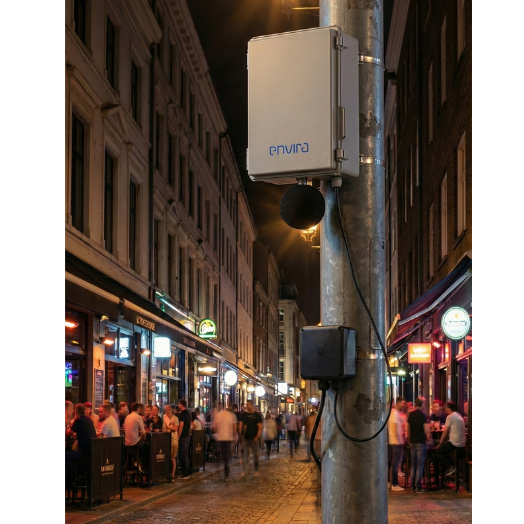
| Infrastructure | Requires tripod, external batteries and on-site surveillance (risk of theft). | Fixed installation on lamppost/pole. | Plug & Play installation: the PGD (streetlight) power option facilitates urban deployment without civil works, turning each light point into a potential control station. |
Nightlife and Special Acoustic Noise Protection Areas
In areas with multiple hospitality, terrace and nightlife activities concentrated in the same location and where the cumulative noise exceeds the limits permitted by law.
To declare Special Acoustic Noise Protection Area, the administration must prove that the levels are persistently exceeded, even late at night or on weekends, making spot sampling unrepresentative.
Nanoenvi dB allows you to obtain the complete ‘acoustic footprint’ without interruption, providing legally valid data for the administrative declaration and, subsequently, objectively verifying the effectiveness of the measures applied in the Zonal Plan.
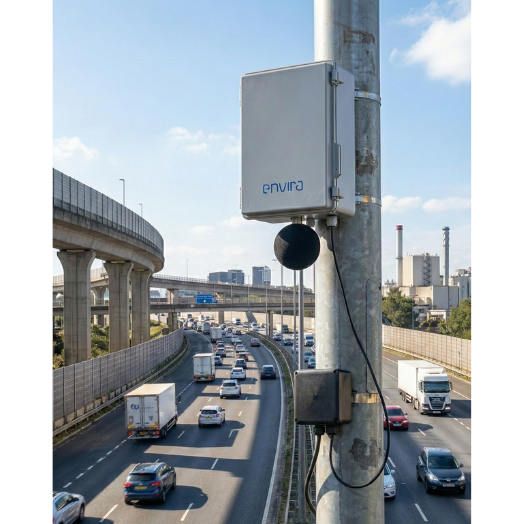
Acoustic monitoring for road traffic and railways
Road traffic and railways are the main source of environmental noise pollution.
Nanoenvi dB enables the deployment of permanent noise monitoring networks along road and railway routes with minimal operating costs after installation. Unlike spot noise sampling, this system captures the full variability of noise (weekends, rush hour, night-time, etc.), ensuring compliance with noise quality objectives.
Its Plug & Play installation in existing lighting systems, with mixed power supply options between mains electricity and battery, facilitates urban and interurban deployment without the need for complex civil engineering works or dedicated infrastructure.
The system not only quantifies sound levels for updating noise maps, but also allows empirical validation of the effectiveness of acoustic screens or sound-absorbing pavements over time.
Data transmission to the proprietary platform enables the direct export of customised reports of assessment indices (Lden), optimising the technical resources of the administration.
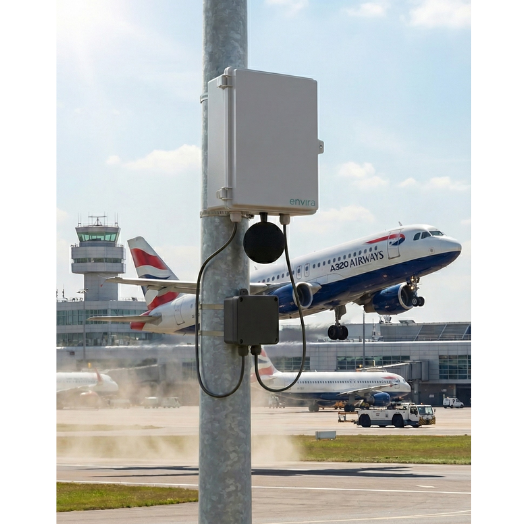
Noise control system for airports and ports
Acoustic management in air and maritime transport infrastructure requires continuous monitoring to validate acoustic easements and ensure compliance with Strategic Noise Maps.
In these cases, spot measurements are insufficient to characterise the variability of high-intensity sound events (take-offs, landings, loading/unloading activity).
Nanoenvi dB is integrated as a fixed 24/7 noise monitoring solution, eliminating the information gaps inherent in manual sampling and ensuring the statistical representativeness necessary for the evaluation of noise indices (Ld, Le, Ln).
Thanks to its certification as Class 1 instrumentation, the data collected is fully legally valid for the management of disciplinary proceedings or the resolution of conflicts with neighbouring communities.
Its robust design with IP65 protection ensures operability even in harsh environments.
Real-time 4G connectivity allows the infrastructure manager to receive immediate alerts when thresholds are exceeded, facilitating active monitoring and operational decision-making based on empirical data, not estimates.
The main difference lies in the accuracy and legal validity required by the UNE-EN 61672 standard. While the Class 1 sound level meter offers maximum accuracy and is mandatory for environmental measurements with legal implications (penalties, zoning, etc.), the Class 2 meter has a higher margin of error and is limited to indicative or occupational controls, lacking full legal validity for monitoring outdoor environmental noise.
More information in the article on how to measure noise pollution
For the data to be legally valid in disciplinary proceedings or acoustic zoning, the equipment must be a Class 1 sound level meter and have a type examination certificate. The Nanoenvi dB system integrates a Class 1 certified sound level meter that complies with the IEC 61672-1:2013 and IEC 61260-1:2014 standards. This guarantees that the measurements have the accuracy and stability required for the assessment and management of noise pollution.
Traditional spot metering provides a limited sample that often does not reflect the full reality of the acoustic environment. Continuous monitoring allows:
Yes, it is an essential tool. In areas saturated with nightlife or traffic, the administration needs to verify whether corrective measures (such as limiting terrace opening hours) are effective. Nanoenvi dB allows for uninterrupted monitoring of whether limits are exceeded during restricted hours, providing objective data to maintain, modify or lift the Special Acoustic Protection Area declaration.
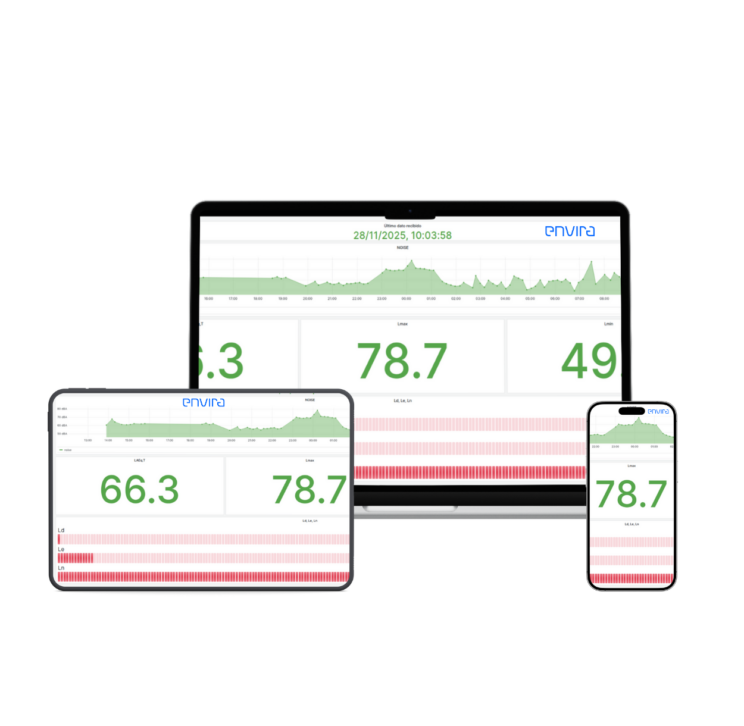
The system calculates and displays the main noise indices:
The platform allows this data to be exported in customised reports for analysis and administrative reporting.
Nanoenvi dB acts as an IoT node thanks to its real-time 4G connectivity. Data is automatically transmitted to a cloud platform where it can be viewed and cross-referenced with other environmental variables. It also allows integration with air quality control networks, facilitating unified environmental management.
Do you want to request your Quotation?