solutions
Urban pollution is not uniform: it varies between streets, intersections, neighborhoods, and even between different times of day. Reference stations are often insufficient to provide a representative and accurate picture of air quality in cities, and their cost and maintenance are a hindrance to tighter municipal budgets.
At Envira, we have the solution: the deployment of hybrid monitoring networks with portable stations based on IoT sensors that complement current reference stations, densifying data collection and obtaining a real, hyperlocal pollution map at a fraction of the cost of traditional infrastructure.
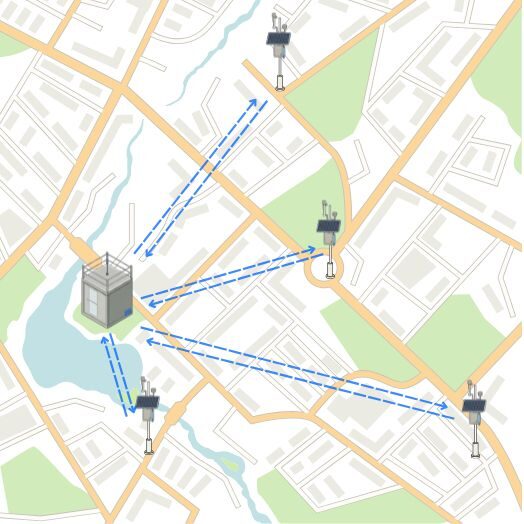
A hybrid urban air monitoring network is an integrated system designed for cities that combines two complementary types of monitoring instruments: certified reference stations that measure with maximum accuracy, and low-cost IoT sensors that expand spatial coverage.
This combination represents an evolution in how we measure and improve urban air quality, which traditionally relied exclusively on one or two reference stations that offered high accuracy but limited spatial coverage. Thanks to wireless environmental monitoring stations, this spatial coverage can be expanded exponentially and much more economically.

Components of the hybrid urban air quality monitoring network:
Total coverage and monitoring of air quality in cities with low-cost sensors
The use of low-cost sensors to monitor urban air quality is becoming increasingly widespread, as their advantages are clear:
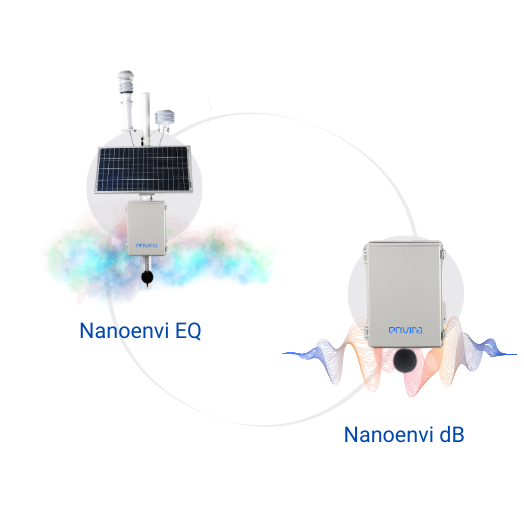
Nanoenvi: low-cost, wireless stations for urban pollution monitoring networks.
Remote calibration system versus reference stations
The biggest challenge in monitoring with electrochemical sensors is correcting drift, that is to say, the loss of accuracy that occurs over time and is inherent to this type of technology.
Nanoenvi devices can be calibrated remotely against a nearby reference station, applying proprietary algorithms that compare the readings of these sensors against the fixed station and apply corrections for any deviations.
This provides indicative measurements with data quality close to that of the reference instrumentation.
The hybrid urban air quality monitoring network includes a real-time data visualization and management platform accessible from any device with an internet connection.
This represents a paradigm shift in environmental governance: while older systems provided daily or monthly averages—a “snapshot” of what had happened with urban air quality—our solution offers a platform that allows for continuous data collection and real-time monitoring of air pollutants, providing a constant and dynamic flow of information.

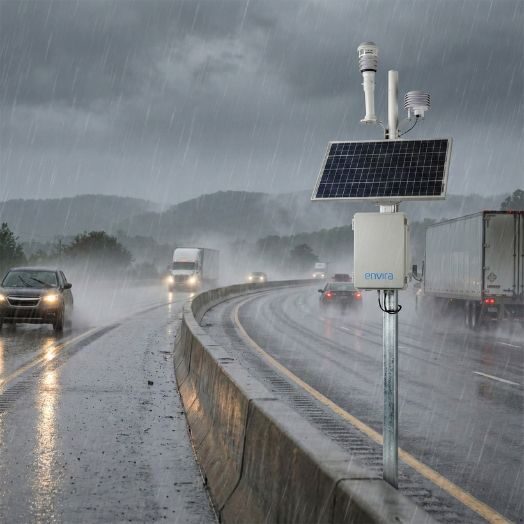
Urban centers and residential areas close to road infrastructure such as roads, highways, motorways, and railways are simultaneously exposed to higher levels of noise and air pollution. This combination significantly increases the health risk to the populations of these residential areas.
In addition, controlling air and noise pollution in this type of linear infrastructure requires covering a large number of kilometers, so the use of low-cost monitoring sensors allows this task to be carried out without incurring a huge investment.
What parameters and pollutants need to be monitored?
Profitability and efficiency
When combined with certified reference instrumentation, a network of wireless stations allows coverage to be multiplied without increasing costs, offering a high-precision solution at a lower cost than traditional infrastructure.
Compliance with LEZ requirements
A hybrid network is the ultimate tool for designing, implementing, and legally justifying Low Emission Zones by providing the objective data required by European and national regulations.
Dynamic pollution map
This monitoring solution based on wireless stations with IoT sensors is the only one that can detect pollution “hot spots” and provide a complete map of the city's actual pollution levels.
Transparency and health
The ability to provide real-time data to citizens through dashboards or apps improves the perception of municipal management and positions the project within the Smart City ecosystem.
No, it supports them. Legislation requires reference stations for official reports to the EU. The Hybrid Network is used for daily management, monitoring of LEZs, and for measuring those areas where the official station does not reach.
Maintenance is minimal. As they are modular, only the electrochemical gas cartridges need to be replaced when they reach the end of their useful life, without having to uninstall the entire unit. Calibration is automatic and remote.
The data is 100% owned by the City Council. The system offers open and integrable communication via MQTT on any Smart City platform in the municipality or on its own dashboards.
The system is configurable, but typically monitors: Nitrogen Dioxide NO₂, Ozone O₃, Particulate Matter PM₁, PM₂.₅, PM₁₀, Carbon Monoxide CO, Sulfur Dioxide (SO₂), as well as environmental noise and meteorological parameters.