en
es en
Phone +34 985 73 39 52

solutions

Perimeter monitoring at industrial facilities

Home » Sectors » Perimeter monitoring at industrial facilities

The new Directive (EU) 2024/1785 transforms fenceline monitoring at industrial facilities from an optional practice to a binding regulatory obligation that must be included in all Integrated Environmental Authorisation (IEA) where there is a quantifiable environmental risk.

Our perimeter monitoring solution is scalable and facilitates compliance with new industrial emissions legislation, demonstrating environmental impact, detecting anomalies in real time, and comprehensively managing operational, regulatory, and reputational risks.

Advantages of implementing a fenceline surveillance system in industry

Legal compliance with the IEP

Legal compliance with the IEP

The CAAQMS comply with the CEN/ISO standards required by law and guarantee valid, auditable data for automatic reporting to the competent authorities.

Full monitoring coverage

Full monitoring coverage

Supplementing monitoring with a network of IoT sensors throughout the industrial site enables extensive monitoring deployments to capture air quality data from multiple strategic locations at a lower cost.

Anomaly detection in real time

Anomaly detection in real time

The perimeter monitoring network enables early detection of emission anomalies, quickly identifying the source of the leak by triangulating the weather with the sensor location.

Defence against claims

Defence against claims

Industrial facilities with perimeter monitoring can easily demonstrate, through automatic correlations, whether the environmental impact is attributable to the facility or to external sources.

Continuous ambient air quality monitoring system for industries

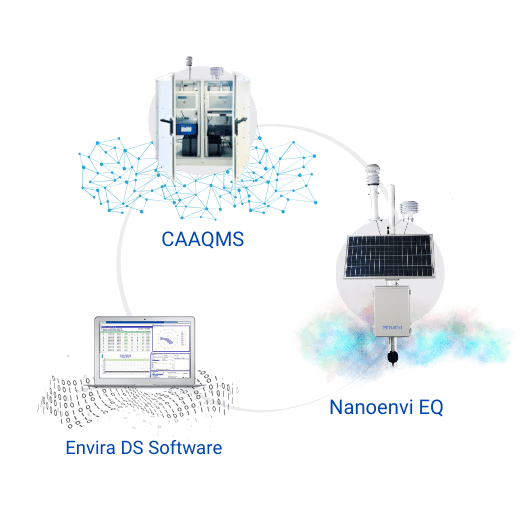
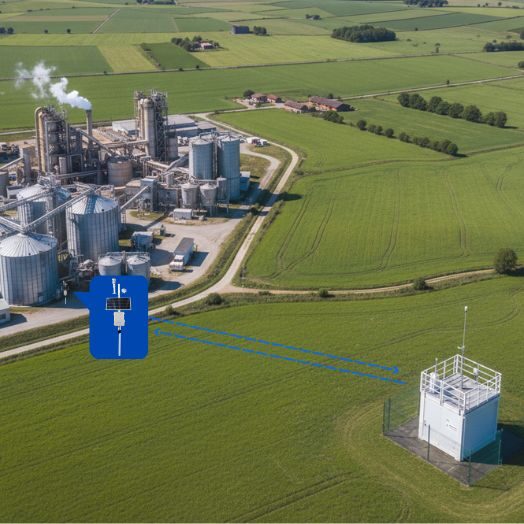
Our solution for measuring and controlling atmospheric pollutants in industrial premises combines the legal accuracy of type approved stations (CAAQMS) with the spatial density of the Nanoenvi EQ sensor network and SCADA software to demonstrate compliance with pollutant concentrations emitted into the receiving environment.

This hybrid architecture not only enables compliance with Directive (EU) 2024/1785, but also provides extensive geographical coverage that detects leaks or anomalies in real time by triangulating the location of sensors and meteorological data.

This comprehensive fenceline monitoring system is based on three pillars:

  • CAAQMS stations (legal compliance): fixed cabins with certified analysers that comply with CEN/ISO standards, ensuring that data is valid for audits, inspections by environmental authorities and litigation.
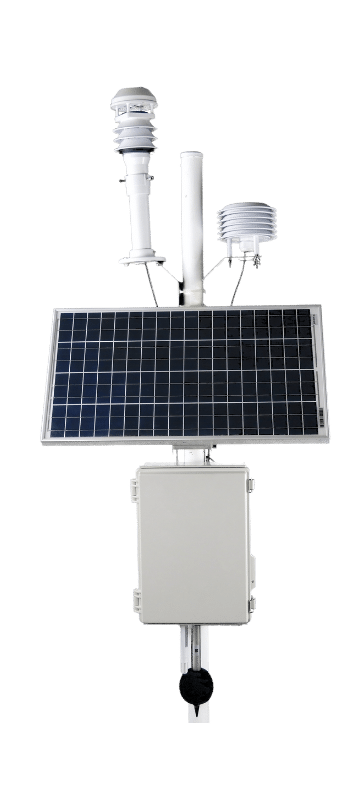
  • IoT Sensor Network (Nanoenvi EQ): multiple measurement points distributed around the perimeter to capture the actual spatial variability of pollutants and perform source attribution analyses by correlating with meteorological data.
  • Envira DS Platform: cloud software for the acquisition, verification and validation of the data collected and its submission to the relevant authorities in the required formats.

Remote calibration of IoT sensors against the type approved station

The type approved station acts as an adjustment point for the entire Nanoenvi EQ sensor network: using proprietary algorithms, the readings from these sensors are compared with those collected by the fixed station, and corrections are applied to account for any deviations inherent in the electrochemical nature of the sensors.

This provides indicative measurements with data quality close to that of the reference instrumentation.

They have already trusted us

Continuous monitoring of industrial pollutants in ambient air

Controlling gas and particle emissions in industry is a matter of growing concern for the community, environmental protection authorities and industrial plant operators.

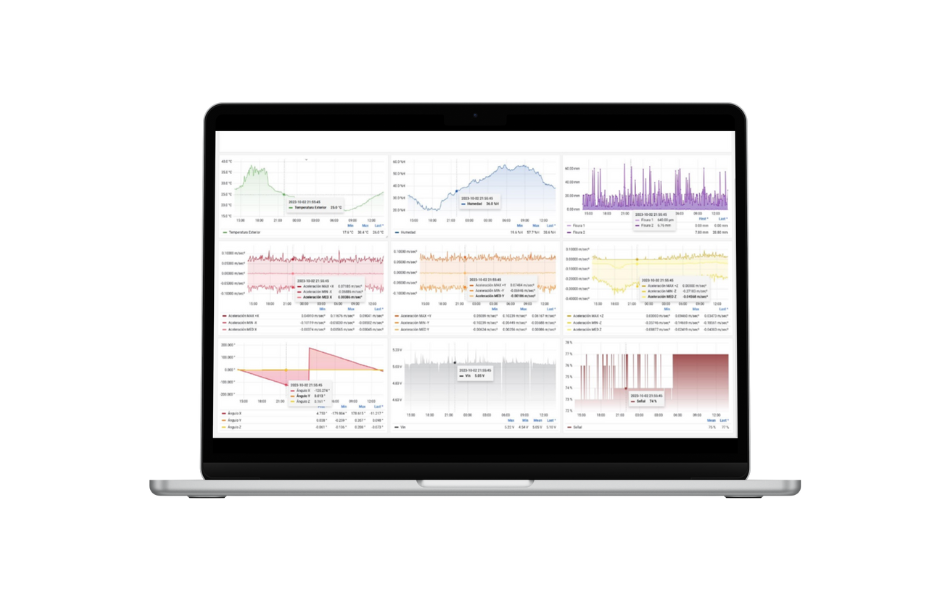
The operation of this comprehensive perimeter monitoring system is very simple: the environmental data collected by both the reference stations and the Nanoenvi EQ IoT devices are integrated into Envira DS, the cloud-based data management software that provides auditable, historical and traceable data.

Infographic on fenceline monitoring data platform in industry

Thanks to this comprehensive, mixed system, plant managers can:

  • Demonstrate that industrial emissions do not compromise the health of nearby communities.
  • Comply with the legal requirements of Directive 2024/1785 regarding data quality.
  • Detect anomalies in real time at any point on the industrial site if concentrations exceed the VLEs, thanks to automatic alerts via email or SMS, thus avoiding incidents or fines.
  • Have a historical archive of measurements and compliance reports ready for the authorities.
  • Facilitate the sending of data to the competent authorities in the official formats requested.
  • Strengthen your social licence through data transparency, demonstrating compliance and improving communication with neighbouring communities.


Comparison between individual systems and the comprehensive monitoring solution

Feature Type-Approved station (CAAQMS) Nanoenvi EQ IoT Sensors Envira Hybrid Solution
Maximum Accuracy and Validity Complies with CEN/ISO standards High (Indicative Quality) Legal and Certified
Legal Compliance Mandatory for official reports Complementary for coverage Complies with Directives 2008/50/EC and 2024/1785
Coverage Area Limited to a fixed point Granular and extensive (dense network) Total (fenceline + critical points)
Leak Detection Difficult due to lack of points Excellent through triangulation Immediate and targeted
Implementation Cost Very high per unit Low and scalable Optimised (faster ROI)

How do we apply IoT sensor technology?

Wireless devices for monitoring gases and particles in perimeter monitoring projects at industrial facilities are equipped with sensors for: H2S, CO, NO2, VOCs, SO2, PM10, PM2.5.

These devices have their own management electronics that monitor the concentrations of pollutants in the air, allowing the identification of risk situations or anomalous events such as the presence of a pollutant or a level exceeding the limit.

If an event posing a risk is identified, an alarm is sent to the data management centre with information on the measurement point, pollutant concentration, date and time. The following can be defined:

  • Virtual perimeters for various gases at low concentrations to monitor emissions.
  • Containment zones for detecting leaks of a specific gas.
  • Multi-level barriers with sensors placed at different levels to monitor the dispersion of gases.

Reliability, stability and accuracy in monitoring

The calibration of sensors included in the solution for the perimeter monitoring at industrial facilities is conducted manually, one by one, at ENVIRA laboratory to internationally acknowledged standards.

Both the calibration process of the equipment at the laboratory and the corrections applied are carried out with the purpose of offering maximum reliability and stability in the results. All the sensors are subjected to tests so that the final results are the most accurate and reliable, a guarantee of accurate and mistake-free monitoring.

Communication modules

Currently, ENVIRA has the following homologated technologies:

Data display, queries and analysis

The data collected by the perimeter monitoring system is transmitted to the IoT platform for data management, from which it is possible to:

  • Receive and store data, both in the local database and in the cloud.
  • Manage users and automatically send alarms.
  • Generate reports.

This solution is interoperable with most industrial systems (SCADA) and industrial IoT platforms (IIoT) to monitor different types of industrial or production process facilities, thus providing a complete and integrated view of all control and information resources in a plant via the MQTT protocol.

Advantages

Open solution, can be integrated with external developments at any level (device, connectivity, CLOUD or user application).

An unlimited number of devices can be included in future expansions.

High-reliable and available data in real time.

Tailored system.

Complete adaptation and integration with emergency plans.

Creation of data history for public administrations.

Frequently Asked Questions (FAQ) about fenceline surveillance in industry

Is fenceline monitoring mandatory in industrial facilities?

Yes, under the new legislative framework of Directive (EU) 2024/1785, fenceline monitoring has gone from being an optional practice to a binding regulatory obligation. It is mandatory for:

  • Industrial facilities operating under an Integrated Environmental Authorisation (IEA) where there is a quantifiable environmental risk.
  • IPPC (Integrated Pollution Prevention and Control) facilities.
  • Cases where the Environmental Impact Assessment (EIA) identifies risks in sensitive areas such as schools, hospitals or nearby homes.
What does Envira's hybrid fenceline monitoring system consist of?

Our solution combines two levels of technology to offer maximum precision at the lowest operating cost:

  • Certified reference stations: high-precision equipment that complies with CEN/ISO standards and provides data that is legally valid before the authorities.
  • Nanoenvi EQ sensor network: IoT devices that enable dense, granular spatial coverage throughout the industrial site.
  • Envira DS software: cloud platform that integrates all data for management, analysis and automatic reporting.
What specific pollutants and parameters can the Nanoenvi EQ device monitor?

The Nanoenvi EQ device is a modular and highly configurable monitoring station that can simultaneously record up to 23 different parameters to provide a comprehensive overview of air quality. Its capabilities include:

  • Polluting gases: it can measure up to 11 gases simultaneously, including NO, NO₂, NOx, O₃, SO₂, H₂S, NH₃, CH₄, CO, CO₂ and Total Volatile Organic Compounds (TVOCs).
  • Particulate matter: continuous monitoring of PM1, PM2.5 and PM10 suspended particles.
  • Integrated environmental parameters: all equipment includes temperature, relative humidity and atmospheric pressure sensors as standard.
  • Meteorological variables (optional): can be supplemented with sensors to measure wind speed and direction, rainfall, solar radiation and illuminance.
  • Environmental noise: recording of noise pollution levels in decibels (dB).

This versatility allows the equipment to be adapted to the specific needs of each sector, whether for dust control in mining, gas detection in the chemical industry or odour monitoring in intensive livestock farming.

How is the quality of Nanoenvi EQ sensor data guaranteed?

Although IoT sensors are more economical, Envira guarantees their accuracy through a continuous remote calibration process.

  • The certified reference station serves as a standard point for the entire sensor network.
  • Proprietary algorithms are applied to compare the readings from the IoT sensors with the reference station.
  • Automatic corrections are made in the event of possible deviations, obtaining data of a quality close to that of the reference instrumentation.
What connectivity options do Nanoenvi EQ sensors offer?

To adapt to the complexity of any industrial environment, the devices support multiple communication protocols: 4G, Wi-Fi, LoRaWAN, and Ethernet.

How does this system help with environmental impact claims?

Perimeter monitoring acts as a proactive defence tool for industry:

  • It provides a simple way of demonstrating whether environmental impact is attributable to the facility itself or to external sources.
  • The system automatically correlates the sensor location, the concentration detected and the weather conditions (triangulation).
  • It facilitates transparency and improves social licence, strengthening communication with neighbouring communities.
see more

Do you want to know more about Perimeter monitoring at industrial facilities?

Contact us