solutions
Water treatment in cooling towers and evaporative condensers requires comprehensive solutions to ensure proper control of the physicochemical, microbiological, and operational parameters that directly affect water quality in these facilities.
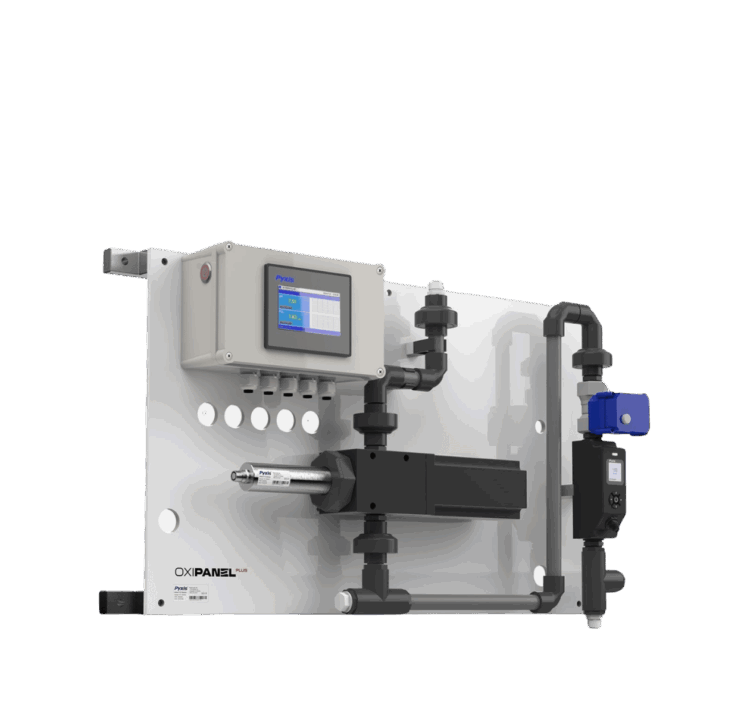
At Envira, we develop solutions for continuous water quality monitoring, controlled blowdown, automatic dosing of biocides and inhibitors and advanced oxidation technologies to ensure health and safety, energy efficiency, and regulatory compliance in industrial cooling facilities.
Legionella and Biofilm
Total Aerobic Bacteria and Turbidity
pH / ORP
Temperature and Flow Rate
Biocide and Chlorine Levels
Conductivity
Cooling towers and evaporative condensers are essential pieces of equipment in industrial processes that require rigorous management of recirculating water. Inadequate monitoring can lead to:
Our solutions are particularly well-suited for sectors where the reliability of the cooling system, health and safety, and energy efficiency are top priorities, such as the chemical, pharmaceutical, paper, cement, steel, refining, and power generation industries (nuclear, thermal, geothermal, and biomass), as well as hospitals, healthcare facilities, and the plastics industry.
Reduction of Health Risks
Continuous monitoring enables the early detection of conditions conducive to the proliferation of Legionella, biofilm, and other microbiological contaminants. This facilitates rapid, preventive action, reducing health risks and improving the safety of the facility.
Regulatory Compliance
Automatic control of critical parameters helps keep a system within the ranges required by applicable regulations. In addition, it provides traceability, data logging, and documentation support for audits, inspections, and maintenance plans.
Performance boost
By monitoring variables such as conductivity, pH, temperature, and biocide levels in real time, scaling, corrosion, and pressure drops are prevented. This keeps heat exchange surfaces clean and ensures more efficient heat transfer.
Water and Energy Savings
Optimizing blowdowns, precise dosing, and control of make-up water help reduce unnecessary consumption. As a result, the system operates more efficiently, with lower chemical usage and reduced energy consumption for pumping and cooling.
The implementation of a comprehensive monitoring and control system for cooling towers and evaporative condensers offers operational, economic, and regulatory benefits: it reduces health risks associated with Legionella, total aerobic bacteria, and biofilm; it improves tower performance by keeping heat exchange surfaces clean; and it saves water and energy through optimized blowdowns and reduced chemical consumption.
In addition, it ensures regulatory compliance with full traceability and technical documentation, reduces unplanned downtime and corrective maintenance, and enables data-driven decision-making with real-time reports and alerts.
Effective water treatment in wet cooling towers requires constant monitoring of key parameters that determine water quality, heat transfer efficiency, and microbiological safety:
The foundation of any water treatment control and quality solution for cooling towers and evaporative condensers is reliable and accurate instrumentation.
These solutions incorporate digital sensors and probes for critical system parameters, ensuring traceability, predictive diagnostics, and compatibility with SCADA monitoring platforms.
All sensors are integrated into a remote monitoring platform that enables real-time visualization, allows for the configuration of alarms for setpoint deviations, and generates automatic reports for audits and regulatory compliance.
We work with instrumentation from leading manufacturers in the field of water quality parameter monitoring and control, such as Pyxis Lab, Endress+Hauser, and Siemens among others, selecting the most appropriate technology for each project based on the criticality of the process, the industrial environment, and integration requirements with existing control systems.
Greater accuracy, early detection of deviations, reduced human error, automatic traceability, time and cost savings, and the ability to respond immediately to incidents.
Cleaning removes accumulated deposits and biofilm, while monitoring prevents their formation through real-time control of physicochemical and microbiological parameters. Both are absolutely essential.
It depends on the system’s criticality and the applicable regulations. In high-risk environments (healthcare, pharmaceutical), monthly or quarterly microbiological testing and daily or continuous physicochemical monitoring are recommended.
Oxidizing biocides (chlorine, bromine, ozone) and non-oxidizing biocides (isothiazolinones, quaternary ammonium salts) are used. The choice depends on water quality, the tower material, and environmental regulations.
By combining the dosing of biocides, scale inhibitors, pH and conductivity control, optimized flushing, and advanced oxidation technologies, continuous monitoring is key to detecting and correcting deviations.
Continuous monitoring, automatic dosing, blowdown control, advanced oxidation technologies, expert maintenance service, and support for regulatory compliance and audits.
Do you want to know more about Industrial cooling towers water monitoring and analysis?